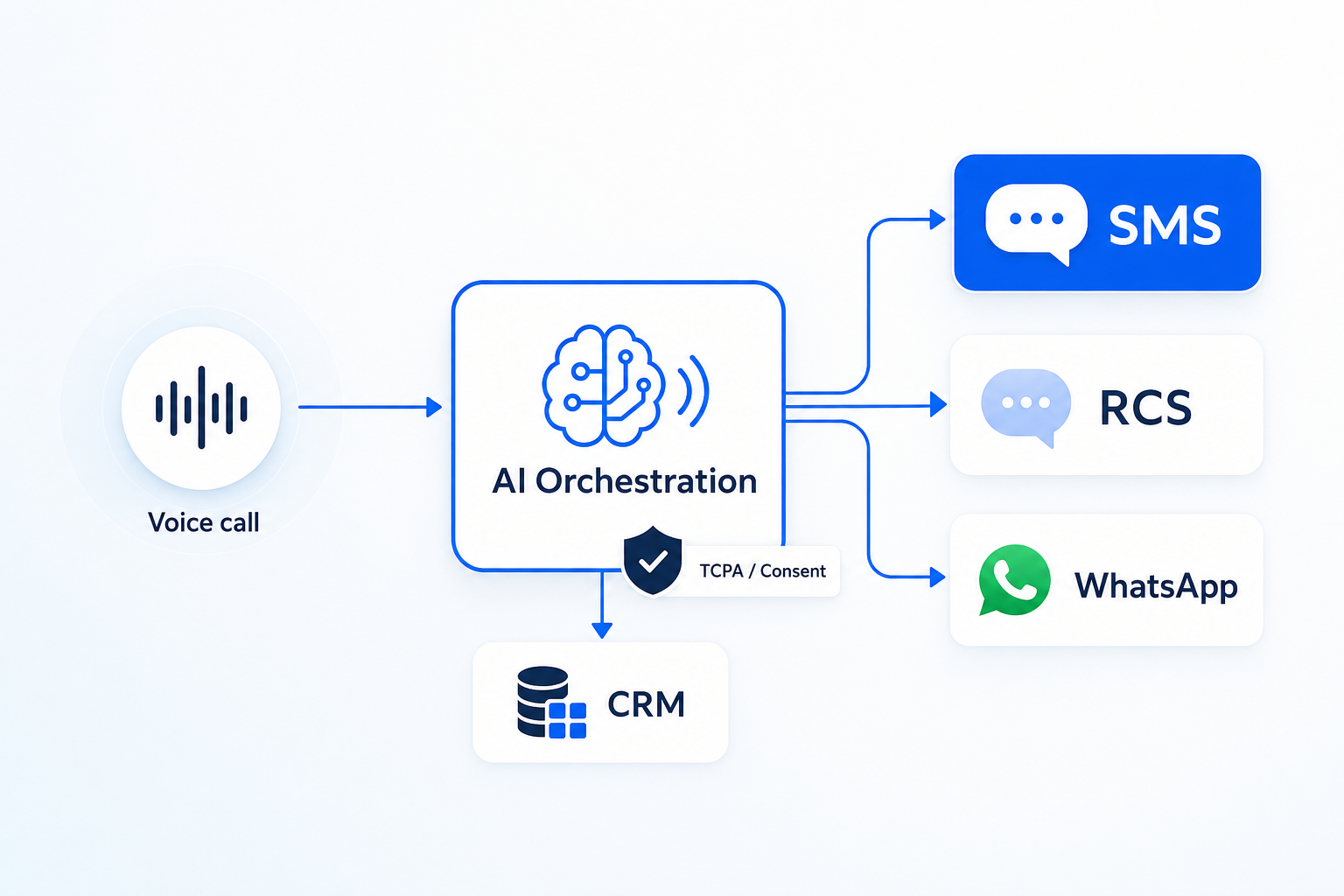
TextConvo orchestrates real-time customer conversations across SMS, email, and voice AI — compliant by default.
Body add-on sentence (in ‘Selection criteria’ section after Compliance by default): “If you’re evaluating TextConvo alongside platforms like Verse.io or Conversica, ask each vendor to show consent proof, universal opt-out handling, and quiet-hours enforcement in a live workflow—not just a slide.”
Body add-on sentence (in ‘Integration and data flow’ section after Bidirectional updates bullet): “For example, TextConvo can write structured outcomes (qualified/unqualified, next step, key fields captured) back to HubSpot or Salesforce so routing rules trigger instantly.”
At TextConvo, we see this shift every day: teams are moving away from batch-and-blast texting and toward AI orchestration—multi-channel, decision-driven conversations that qualify leads in minutes, not days. This post offers an honest comparison of six widely discussed platforms—TextConvo, Meera, Thoughtly, Verse.io, Conversica, and Regal.io—with clear selection criteria and a practical feature table.
Important note on performance claims: vendor results vary by industry, list quality, and compliance posture. Where we cite TextConvo outcomes (e.g., “2.3x reply rate” and “40% faster qualification”), treat them as reported customer outcomes in specific deployments, not universal guarantees.
Primary keyword and what you should actually be buying
When people search for the “best AI SMS platforms for lead qualification,” they’re usually trying to solve one of these business problems:
- Speed to lead: leads go cold within minutes.
- Low contact rates: prospects ignore calls and emails.
- Sales bandwidth constraints: reps can’t work every inbound lead.
- Compliance risk: TCPA, consent, quiet hours, and opt-out management are hard to operationalize.
- Channel fragmentation: SMS works—until it doesn’t; then you need email, WhatsApp, or voice.
The market is shifting fast: the messaging industry is moving from “bulk messaging tools” and “single-channel bots” to signal-based, multi-channel orchestration. In other words: the platform should decide what to do next based on real-time signals—not just send a predetermined sequence.
Selection criteria: how to evaluate AI lead-qualification platforms
Before comparing vendors, anchor on criteria tied to revenue and risk—not demos.
1) Orchestration vs. single-channel automation
Ask:
- Does the platform coordinate SMS + email + WhatsApp/RCS + voice in one conversation?
- Can it change course midstream based on signals (reply content, intent, time of day, consent state)?
- Does it support “agentic” behavior (taking actions like scheduling, routing, and updating CRM), or does it just chat?
Why it matters: A lead that doesn’t respond to SMS at 2pm might respond to a short email at 6pm—or pick up a voice AI call if the offer is time-sensitive.
2) Qualification depth (not just “engagement”)
Look for:
- Configurable qualification frameworks (BANT-like, custom fields, scoring)
- Handling objections and branching logic
- Multi-step data capture (budget, timing, location, eligibility)
- Smooth handoff: live rep, calendar, or call transfer
Pitfall to avoid: Some “AI” tools are strong at getting replies, weak at extracting structured qualification data that your CRM can use.
3) Compliance by default (TCPA + consent tracking)
For US-based lead gen, this is table-stakes:
- Consent capture + proof (source, timestamp, language)
- Universal opt-out enforcement across channels
- Quiet hours + local-time routing
- Message templates and auditability
Pitfall to avoid: A tool that makes compliance “your job” becomes a liability when you scale.
4) Integration and data flow
Ask:
- Native integrations or flexible webhooks for CRM (Salesforce, HubSpot, etc.)
- Bidirectional updates (AI writes qualification outcomes back to CRM)
- Lead routing rules (territory, availability, priority)
- Attribution and reporting you can trust
5) Cost model that matches your motion
Common pricing models include:
- Per seat (good for rep-focused workflows)
- Per conversation / per lead (good for marketing-led inbound)
- Usage-based messaging + AI compute
Tip: Map cost to your funnel math: CPL → contact rate → qualified rate → booked rate.
Comparison table: TextConvo vs. Meera vs. Thoughtly vs. Verse.io vs. Conversica vs. Regal.io
This table is intentionally practical. Some items vary by package and implementation; use it as a shortlist accelerator.
| Platform | Best for | Orchestration (multi-channel) | Voice AI escalation | Signal-based decisioning | TCPA/consent controls | CRM & routing depth | Notes to validate in demo |
|---|---|---|---|---|---|---|---|
| TextConvo | High-velocity inbound + compliance-sensitive teams needing end-to-end orchestration | Yes (SMS/RCS/WhatsApp/email/voice) | Yes (escalate to voice AI when appropriate) | Yes (AI Decision Engine style orchestration) | Strong emphasis; consent tracking + universal opt-out | Strong; built for operational routing and outcomes | Ask to see: consent proofing, opt-out propagation, voice escalation triggers, CRM writeback fields |
| Meera | Teams seeking AI-led outreach/engagement with conversational workflows | Varies (confirm channels supported) | Varies | Varies | Varies | Varies | Ask: how qualification data becomes structured fields; compliance controls and audit trail |
| Thoughtly | Voice-forward AI experiences and automated calling motions | Some (often voice-centric; confirm SMS/email scope) | Strong (voice focus) | Varies | Varies | Varies | Ask: how it coordinates with SMS for speed-to-lead; how handoffs and consent work |
| Verse.io | Inbound lead engagement and human/AI-assisted follow-up for marketing leads | Typically SMS-forward (confirm full channel mix) | Limited/partner-dependent | Varies | Varies | Varies | Ask: what’s automated vs. managed service; SLA on speed-to-lead; reporting transparency |
| Conversica | Sales/marketing assistant style follow-up across larger databases | Multi-channel (often email/SMS; confirm) | Limited/varies | More sequence-based; confirm signal handling | Varies | Strong enterprise integration options | Ask: how it handles real-time inbound vs. long-cycle re-engagement; customization of qualification logic |
| Regal.io | Lifecycle orchestration for consumer-style experiences, outbound + inbound coordination | Strong multi-channel | Varies/partner-dependent | Strong (journeys + triggers) | Varies | Strong; event-driven tooling | Ask: how “AI agent” behaves vs. workflow engine; SMS compliance posture and opt-out controls |
How to use this table: Pick two “must-haves” (e.g., voice escalation + strict TCPA controls) and two “nice-to-haves” (e.g., WhatsApp, RCS). Then go vendor by vendor and force a yes/no answer with a live workflow test.
Platform-by-platform: where each option tends to fit
Below is a candid “fit” view—less about marketing copy, more about where these tools are commonly positioned.
TextConvo: signal-based AI orchestration for real-time lead qualification
TextConvo is built around AI orchestration: the system chooses the next best action based on signals—reply intent, consent state, time-of-day, lead priority, and outcomes.
Where it stands out in practice:
- Signal-based orchestration (not just sequences): Your flow adapts when the lead says “call me,” “not now,” or asks pricing.
- Escalation to voice AI: When texting is too slow (or the lead asks to talk), the conversation can escalate to a voice AI experience without losing context.
- TCPA compliance by default: Consent tracking and universal opt-out are designed into the conversation layer rather than bolted on later.
- Reported customer outcomes: In some deployments, customers report 2.3x higher reply rates and 40% faster qualification when moving from manual/batch texting to orchestrated, real-time conversations.
If you want to see what orchestration looks like end-to-end, start with our AI orchestration platform overview.
Meera: conversational engagement with an AI layer
Meera is often evaluated by teams that want an AI-led engagement experience without building everything from scratch.
Validation checklist:
- Which channels are truly native (SMS only vs. multi-channel)?
- Can it handle complex qualification (multiple attributes, disqualifiers, scoring)?
- How does it log consent and opt-outs (and can you export proof)?
Thoughtly: strong when voice is the center of gravity
Thoughtly is frequently positioned in the voice AI category. If your lead motion depends on calls (e.g., insurance, home services, appointment setting), voice-forward platforms can be compelling.
Validation checklist:
- Can it coordinate with SMS for speed to lead (text first, call next)?
- Does it maintain one continuous conversation history across channels?
- How does it manage compliance (call recording notices, opt-outs, quiet hours)?
Verse.io: marketing-led inbound follow-up and engagement
Verse.io is commonly used for inbound lead engagement, sometimes with managed service elements.
Validation checklist:
- What’s automated vs. what relies on a service team?
- How quickly does a lead get a first touch at scale?
- Can the platform output structured qualification fields back to your CRM?
Conversica: assistant-style re-engagement and pipeline nurturing
Conversica is well known for automated assistants that follow up with leads and contacts over time.
Validation checklist:
- Is it optimized for real-time inbound lead qualification or longer-cycle nurture?
- How easy is it to customize qualification logic and escalation paths?
- Are SMS compliance controls first-class or configuration-heavy?
Regal.io: event-driven lifecycle journeys at scale
Regal.io is often considered when teams want triggered outreach and lifecycle orchestration (e.g., based on product events, cart activity, or inbound intent).
Validation checklist:
- Is the “AI” primarily generative messaging, or does it truly reason and act (agentic behavior)?
- How does it manage channel policies and opt-outs across SMS/email/WhatsApp?
- Can it support a sales qualification use case (not just lifecycle marketing)?
The biggest market shift: from bulk messaging to agentic AI orchestration
Across the messaging industry, the trend is clear:
- Channel changes: SMS is foundational, but RCS and WhatsApp are gaining importance; email remains critical; voice AI is becoming a practical escalation path.
- Regulatory evolution: TCPA enforcement, carrier filtering, and consent expectations are rising. Platforms that treat compliance as a product feature win.
- Practical implications: “Campaigns” are being replaced by real-time conversations where the system senses, decides, and acts.
This is why the best platforms increasingly look like orchestration layers—connecting signals, channels, and actions—rather than simple texting tools.
How to choose: a simple decision framework (with examples)
Use this framework to shortlist quickly.
Step 1: Define your qualification goal (and your bottleneck)
Pick the primary constraint:
- Contact rate is low → you need channel testing + better opening moves.
- Response rate is low → you need personalization + timing + compliance hygiene.
- Qualification depth is low → you need structured data capture + branching.
- Booked rate is low → you need better routing, voice escalation, and rep handoff.
Step 2: Match platform strengths to your motion
Common motions and what to prioritize:
- Inbound, high volume (paid leads, forms, calls): prioritize speed-to-lead, orchestration, routing, compliance.
- Long-cycle nurture (B2B pipeline, dormant leads): prioritize multi-touch sequences, CRM alignment, reporting.
- Appointment-heavy (local services, clinics): prioritize voice + calendar actions + missed-call workflows.
Step 3: Run a “proof” pilot—not a demo
In your pilot, require:
- A real lead source (form, call, or webchat) feeding production-like data
- At least 3 qualification outcomes (Qualified, Nurture, Disqualified)
- A compliance audit trail (consent, opt-out, timestamps)
- CRM writeback (fields populated, tasks created, stages updated)
To get ideas for what a real pilot should look like, review these real-world use cases.
TextConvo differentiators (why orchestration wins)
If your team is comparing AI SMS platforms primarily on “does it send texts,” you’ll end up with tools that plateau quickly. The differentiators that matter show up at scale.
1) Signal-based orchestration that adapts mid-conversation
Examples of signals that should change the next step:
- Lead says: “Can you call me in 10?” → schedule a voice AI call or rep callback.
- Lead asks: “Do you serve my zip code?” → capture location, route appropriately.
- Lead replies outside business hours → respect quiet hours, continue next day.
2) Voice AI escalation without losing context
A common failure mode in lead qualification is “texting gets stuck.” Voice escalation (AI or human) can resolve:
- Complex objections
- Multi-party decisions
- High-intent “call me now” requests
3) Compliance that’s operational, not aspirational
Practical compliance features you want on by default:
- Consent state as a first-class object
- Universal opt-out across channels
- Audit-friendly logs for disputes
4) Outcomes-focused reporting
You need to measure:
- Speed-to-lead (median and 90th percentile)
- Contact rate and reply rate by source
- Qualification rate and time-to-qualify
- Handoff success rate (did a rep actually connect?)
If you want to talk through your specific funnel and see whether orchestration is the missing layer, you can contact our team.
Actionable takeaways (what to do this week)
- Rewrite your first message to be permission-based and specific (who you are, why you’re texting, a single question).
- Add at least two qualification branches (e.g., “ready now” vs. “researching”) and define what happens next.
- Implement universal opt-out and confirm it propagates across every channel you use.
- Create a voice escalation rule for high-intent signals (“call me,” “available now,” “need this today”).
- Force CRM writeback: every conversation should end with structured fields, not just a transcript.
Frequently Asked Questions
What is the best AI SMS platform for lead qualification?
The “best” platform depends on your motion. If you need real-time, multi-channel decisioning with compliance controls and the option to escalate to voice AI, prioritize orchestration-first platforms. If you mainly need long-cycle re-engagement, an assistant-style platform may be sufficient.
Do I need multi-channel orchestration if SMS works well today?
Usually, yes—because SMS performance fluctuates by audience, carrier filtering, and timing. Orchestration gives you resilience: when SMS doesn’t convert, the system can shift to email, WhatsApp, RCS, or voice AI while keeping one conversation history and consistent opt-out behavior.
How do these platforms handle TCPA compliance?
Approaches vary. Look for consent capture and proof, quiet-hour enforcement, and universal opt-out. If a vendor frames compliance as “configure it yourself,” plan extra time for legal review, implementation, and ongoing audits.
Can AI actually qualify leads, or does it just chat?
AI can qualify leads if it’s designed to capture structured data and drive outcomes (e.g., eligibility, timeline, budget, location) and then take actions (route, schedule, escalate). If it only generates friendly responses without updating your CRM or triggering next steps, it’s engagement—not qualification.
What should I test in a pilot before committing?
Test speed-to-lead, reply/contact rate, qualification rate, and CRM writeback quality. Also validate consent/opt-out logging and what happens when a lead asks for a call, opts out, or replies outside business hours.
Conclusion: choose orchestration, not just texting
AI SMS is becoming a competitive requirement—but the winners won’t be the teams that “send more texts.” They’ll be the teams that orchestrate real-time customer conversations across channels, use signals to decide the next best action, and treat compliance as a default operating system.
If you’re evaluating options, shortlist based on orchestration depth, qualification outcomes, and compliance posture—not just features on a slide.
See how TextConvo can help — visit textconvo.ai to get started.
Author: TextConvo Team
🚀 See TextConvo in action
- 👉 Explore our Product
- 👉 View real Use Cases
- 👉 Contact us to get started
Tags