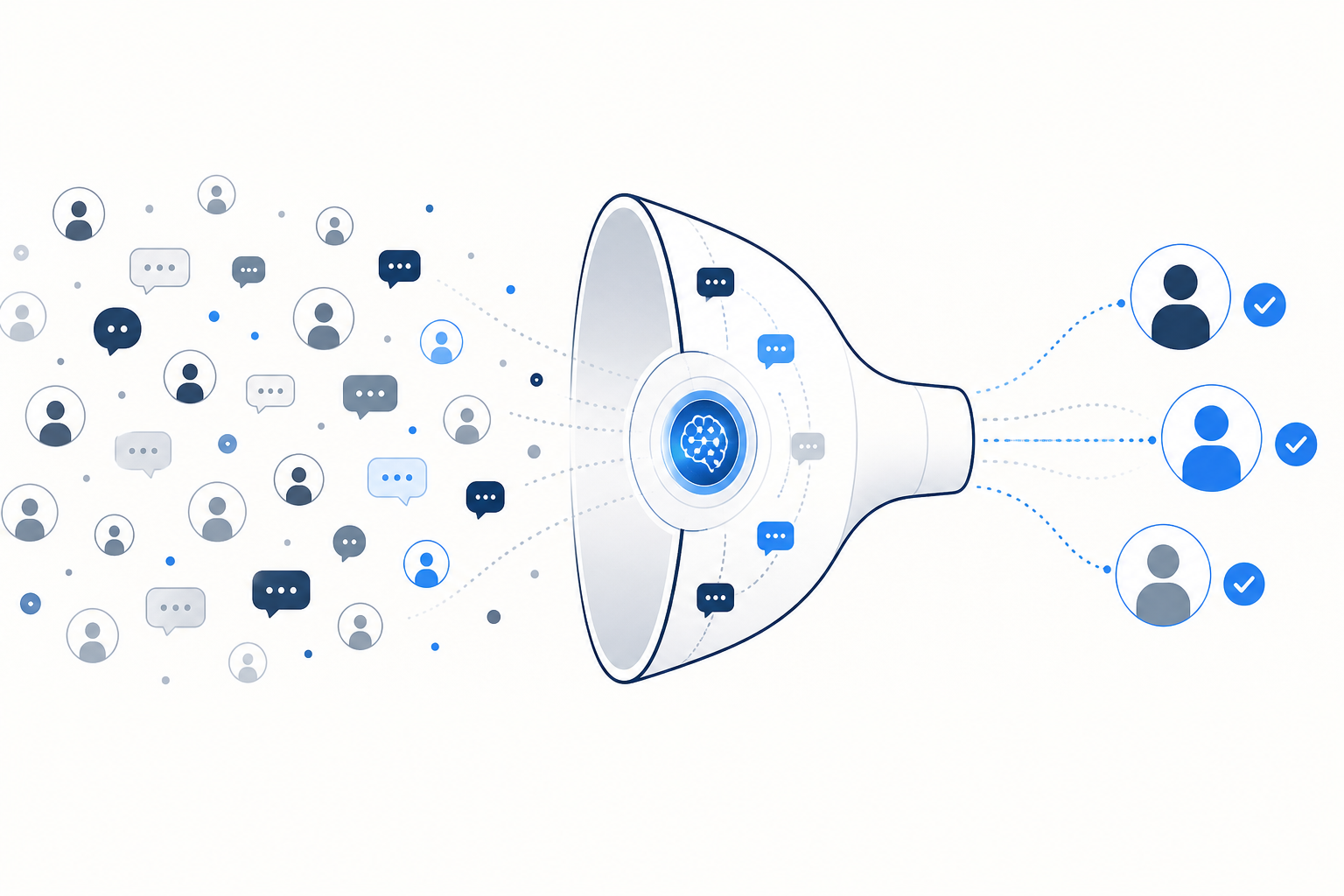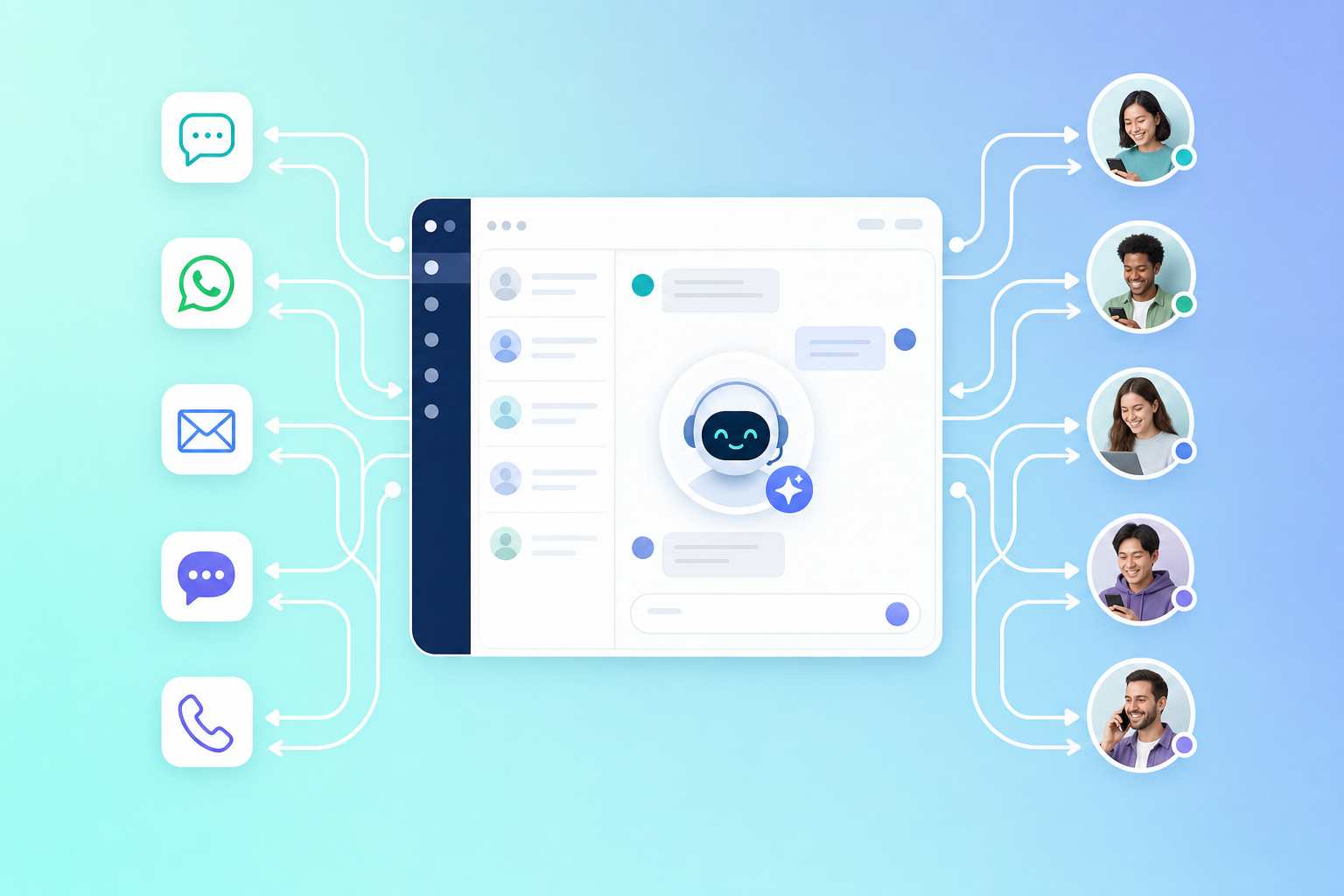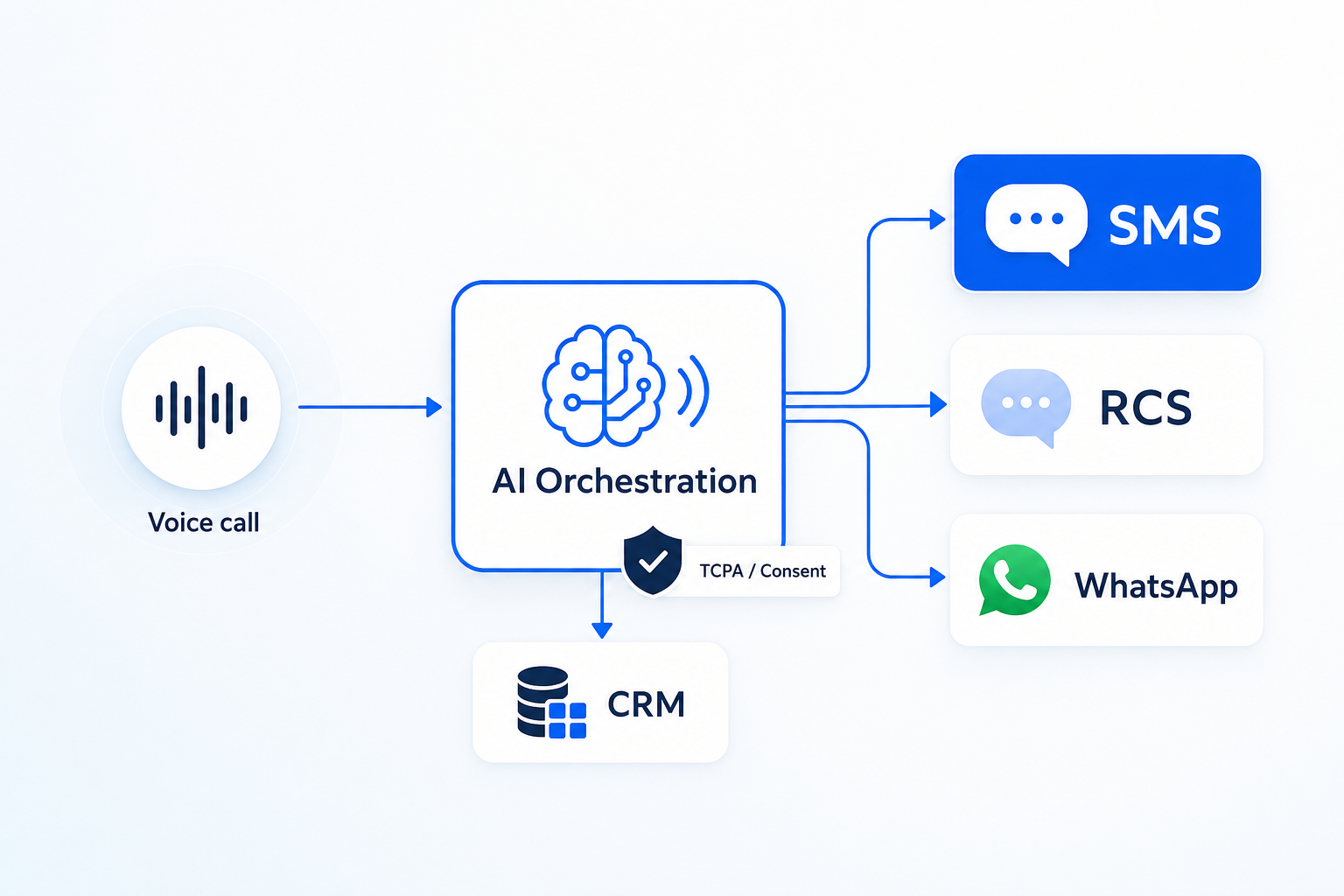
Multi-channel customer communication used to be “pick a channel, pick a tool, send a campaign.” That model is breaking. Buyers bounce between SMS, email, WhatsApp, web, and phone, which is why AI orchestration platforms like TextConvo read signals and decide what to send, where, and when across SMS, RCS, WhatsApp, email, and voice; meanwhile carriers and inbox providers keep tightening deliverability rules, and regulators increasingly expect provable consent and opt-out handling.
Multi-channel AI orchestration is the practical response: a way to run real-time customer conversations across channels using a decision layer that reacts to signals (intent, behavior, compliance status, availability) rather than rigid workflows. That’s the lens TextConvo was built for—signal-based, agentic orchestration that connects SMS, RCS, WhatsApp, email, and voice AI into one operating system for conversations.
This post breaks down what multi-channel AI orchestration actually is, why it’s the wedge with the most leverage (and less noise than “SMS marketing”), and how business owners and marketers can implement it without boiling the ocean.
Why Multi-Channel AI Orchestration Is the New Messaging Baseline
The messaging industry is moving through a set of market shifts that make single-channel strategies fragile:
- Channel fragmentation is permanent. Some customers live in SMS, others respond only to email, others prefer WhatsApp, and some want a phone call—depending on urgency, context, and geography.
- Regulatory evolution is accelerating. Consent requirements, opt-out rules, and audit expectations are tightening (TCPA in the U.S. is the headline, but similar patterns exist globally).
- Carrier and inbox enforcement is stricter. Deliverability is no longer “set it and forget it.” Filtering, throttling, and brand trust signals matter.
- Customer expectations are now conversational. People expect to ask a question, get an immediate answer, and continue the thread later—without repeating themselves.
In that environment, “more messages” is not the answer. Better decisions are.
Multi-channel AI orchestration becomes the baseline because it does three things traditional tooling can’t do well:
- Coordinates channels instead of competing with them. The system chooses the next-best channel per customer and moment.
- Responds in real time to signals. Example: a lead clicks a quote link—your next outreach changes instantly.
- Bakes in compliance and preference handling. Consent, quiet hours, and universal opt-out are not afterthoughts.
Orchestration vs. Automation vs. “Omnichannel”
These terms get muddled. Here’s a clean way to separate them:
- Automation: “If X, then Y” workflows (often brittle, hard to maintain).
- Omnichannel: Multiple channels available, but often run in parallel silos.
- Multi-channel AI orchestration: A decision engine that routes, sequences, and adapts conversations across channels based on signals and outcomes.
Orchestration is not a bigger workflow builder. It’s a control system.
The Wedge: From Bulk Messaging to Signal-Based, Agentic Conversations
Most competition sits in crowded categories:
- SMS campaigns
- marketing automation
- call center software
- chatbot widgets
The higher-leverage—and less competitive—position is the orchestration layer that connects them.
What “signal-based AI” means in practice
A signal is any input that should change the next action. In real customer conversations, that includes:
- Intent signals: “pricing,” “cancel,” “need help,” “call me”
- Behavior signals: link clicks, form completion, missed calls, email opens (where available)
- Lifecycle signals: new lead, active customer, renewal window, payment failure
- Operational signals: agent availability, store hours, appointment capacity
- Compliance signals: consent status, opt-out, channel eligibility, quiet hours
A signal-based AI orchestration system uses those inputs to decide:
- Should we message at all?
- Which channel is appropriate right now?
- Should a human take over, or can AI resolve this?
- What’s the next-best question to move the conversation forward?
This is where agentic AI becomes useful—not as “a chatbot that talks,” but as an agent that can:
- gather missing info (lead qualification)
- complete a task (schedule, reschedule, take a deposit, send a form)
- hand off cleanly to a human with context
If you want to see what this looks like when done end-to-end, start with our AI orchestration platform.
The strategic advantage for business owners and marketers
When you compete on “send messages,” you’re in a race to the bottom.
When you compete on orchestrated outcomes, you win on:
- Speed to lead (response time measured in seconds, not hours)
- Higher conversion rate (because the channel and content match the moment)
- Lower cost to serve (AI handles routine questions; humans handle edge cases)
- Reduced compliance risk (consistent consent and opt-out enforcement)
Most importantly, orchestration creates a compounding advantage: every conversation generates more signals, which improves future routing and follow-up.
How Multi-Channel Orchestration Actually Works (A Practical Model)
Forget diagrams with 30 boxes. A workable orchestration model has four layers:
1) Identity + consent as the foundation
Before you orchestrate, you need consistent identity and compliance handling:
- unify customer profiles across channels (phone, email, WhatsApp identity)
- record consent source and scope (what channel, what purpose)
- enforce opt-out and suppression globally (universal opt-out)
If your “STOP” only applies to one channel or one system, your risk is higher than you think.
2) A decision layer (the AI Decision Engine)
This is where orchestration happens:
- ingest signals in real time
- determine eligibility (consent + policy)
- select channel (SMS vs. RCS vs. WhatsApp vs. email vs. voice AI)
- generate or select the next message/action
- choose escalation path (human handoff)
3) Channel execution + threading
The customer experience should feel like one ongoing conversation, even if:
- the first touch is SMS
- the follow-up is email
- the “high intent” moment triggers a voice AI call
- the customer later responds on WhatsApp
Threading and context continuity are what separate orchestration from “multi-channel blasting.”
4) Feedback loops and learning
The system should track outcomes like:
- contact rate per channel
- time-to-first-response (speed to lead)
- qualification completion rate
- appointment set rate
- resolution rate without human intervention
- opt-out rate and complaint signals
Then it should adjust routing and playbooks based on what works.
Real Scenarios Where Orchestration Beats Single-Channel Messaging
The fastest way to understand the value is to map it to real operational moments.
Scenario 1: Lead qualification that doesn’t stall
Problem: Leads come in after hours. You send an email. They reply the next day—or never.
Orchestrated approach:
- Lead submits form → instant SMS asking 2–3 qualifying questions.
- If no response in 10 minutes → follow up via email with the same questions.
- If they click “Talk today” → trigger voice AI to call and offer times.
- If they opt for WhatsApp → continue there with the same thread context.
Outcome: faster qualification, fewer lost leads, cleaner handoff to sales.
Scenario 2: Appointment management with fewer no-shows
Problem: Reminders go out, but customers don’t confirm. Staff chase manually.
Orchestrated approach:
- Send an RCS rich reminder (where available) with confirm/reschedule buttons.
- If not supported, fall back to SMS with simple replies.
- If customer asks a question (“Do you take my insurance?”) → AI answers or escalates.
- If they don’t confirm by a cutoff time → voice AI calls with a last-chance reschedule.
Outcome: fewer no-shows, less staff time spent on back-and-forth.
Scenario 3: Collections / payment recovery without burning trust
Problem: Payment failure triggers an email. Customer ignores it. Account churns.
Orchestrated approach:
- Start with a low-friction SMS: “Quick heads up—your payment didn’t go through. Want a link to update?”
- If they reply with concern → AI handles common issues and offers options.
- If no response → email with invoice + context.
- If high-risk account → route to a human agent or voice AI for a more empathetic touch.
Outcome: improved recovery while protecting brand experience.
For more scenario patterns you can adapt, see real-world use cases.
Implementation Playbook: How to Adopt Orchestration Without Overhauling Everything
Most teams fail by treating orchestration like a giant transformation project. Instead, implement it in controlled steps.
Step 1: Pick one high-value journey
Good starting points:
- inbound lead qualification
- appointment scheduling and reminders
- abandoned cart / quote follow-up
- customer support triage
Pick the one with:
- high volume
- clear success metric
- expensive manual handling
Step 2: Define your signals and decision rules
Start with a small, explicit set:
- consent status (per channel)
- working hours / quiet hours
- intent categories (pricing, scheduling, support, cancellation)
- lead stage (new, contacted, qualified)
You can begin with deterministic rules and layer AI on top as you learn.
Step 3: Design channel fallback paths
A simple fallback ladder might look like:
- preferred channel (if known)
- SMS (fastest reach for many U.S. audiences)
- email (long-form backup)
- voice AI (for high-intent or urgent cases)
The key is not “use every channel.” It’s use the right channel next.
Step 4: Build a human handoff that sales/support will actually use
Handoffs fail when the human has to ask the same questions again.
Minimum handoff packet:
- conversation summary
- captured fields (needs, budget, timeline, location)
- last customer message
- recommended next action
Step 5: Put compliance on rails (don’t improvise)
At minimum, ensure:
- TCPA-aware consent tracking
- universal opt-out across channels where applicable
- clear templates for required disclosures
- audit logs for consent and message history
If you’re unsure where your gaps are, contact our team and we’ll help you pressure-test your journey design.
Metrics That Prove Orchestration Is Working
Avoid vanity metrics like “messages sent.” Focus on outcomes.
Core business metrics
- Speed to lead: time from inquiry to first meaningful response
- Qualification rate: % of leads that complete required questions
- Conversion rate: appointments set, demos booked, orders placed
- Cost to serve: manual touches per case, agent minutes saved
Channel health metrics
- contact rate by channel
- fallback success rate (did the second channel rescue the conversation?)
- opt-out rate by journey step (identify friction)
Compliance and trust metrics
- suppression accuracy (no messages after opt-out)
- complaint and escalation signals
- consent coverage (what % of contacts have provable consent for each channel)
Frequently Asked Questions
1) What is multi-channel AI orchestration in plain English?
It’s a system that decides how to continue a customer conversation—what to say, when to say it, and which channel to use—based on real-time signals like intent, behavior, and consent status.
2) Do I need to use every channel (SMS, RCS, WhatsApp, email, voice AI)?
No. Orchestration is about choice and sequencing, not channel collection. Many businesses start with two channels (often SMS + email) and add voice AI or WhatsApp where it improves outcomes.
3) How is this different from marketing automation?
Marketing automation typically runs scheduled campaigns and static workflows. Multi-channel AI orchestration is designed for real-time conversations, dynamic routing, and adaptive follow-up—especially when customers reply in unpredictable ways.
4) Where does RCS fit into an orchestration strategy?
RCS can add rich, app-like interactions (buttons, carousels, branded experiences) in supported environments. In orchestration, RCS is a high-bandwidth option—but you still need graceful fallback to SMS when RCS isn’t available.
5) How do you handle TCPA and opt-outs across multiple channels?
You need consistent consent tracking, clear purpose-based permissions, and a suppression system that enforces opt-outs reliably. The goal is a universal view of permissioning so you don’t accidentally message someone on a different channel after they’ve opted out.
Conclusion: The Next Era Is Orchestrated, Not Broadcast
As you finalize your omnichannel AI orchestration platform buyer guide, pressure-test how the vendor’s roadmap anticipates regulatory evolution and channel changes without forcing costly rework. The strongest platforms translate policy updates, consent requirements, and regional data rules into configurable guardrails that marketing, service, and collections teams can actually operate. Just as important, they support the shift from bulk to orchestration—using real-time context and intent to choose the right channel, tone, and next-best action—so automation improves customer experience instead of multiplying noise or risk.
What’s changing fastest isn’t just tooling—it’s the messaging industry itself. As trends and market shifts reshape how people move between SMS, RCS, WhatsApp, email, and voice, teams need a decision layer that can adapt to channel changes without rebuilding workflows every quarter. The practical implications show up in deliverability, consent capture, and escalation to humans when risk or urgency is high—especially as regulatory evolution raises the bar for provable opt-ins and unified opt-outs. Treat an omnichannel AI orchestration platform as your operating system for ai in customer communications: one brain that routes, sequences, and learns across channels while keeping compliance and customer context intact.
The market is shifting from bulk messaging and channel-specific tools to multi-channel AI orchestration—a model where real-time signals drive the next-best action across SMS, RCS, WhatsApp, email, and voice AI.
For business owners and marketers, this is more than a tech trend. It’s a practical way to:
- respond faster when intent is highest
- qualify and convert more leads without adding headcount
- reduce compliance risk as regulations evolve
- create customer experiences that feel continuous, not fragmented
See how TextConvo can help — visit textconvo.ai to get started.
Author: TextConvo Team
🚀 See TextConvo in action
- 👉 Explore our Product
- 👉 View real Use Cases
- 👉 Contact us to get started
Tags